
Introduction
Overall Equipment Effectiveness (OEE) is one of the most important performance metrics in modern manufacturing. Yet many plants still struggle with inaccurate OEE calculations, delayed reporting, and hidden production losses.
Manual tracking, disconnected systems, and reactive maintenance prevent operations teams from gaining real-time visibility.
Industrial IoT changes that.
In this article, we explore how manufacturers can improve OEE using connected systems, real-time monitoring, and data-driven insights.
What Is OEE?
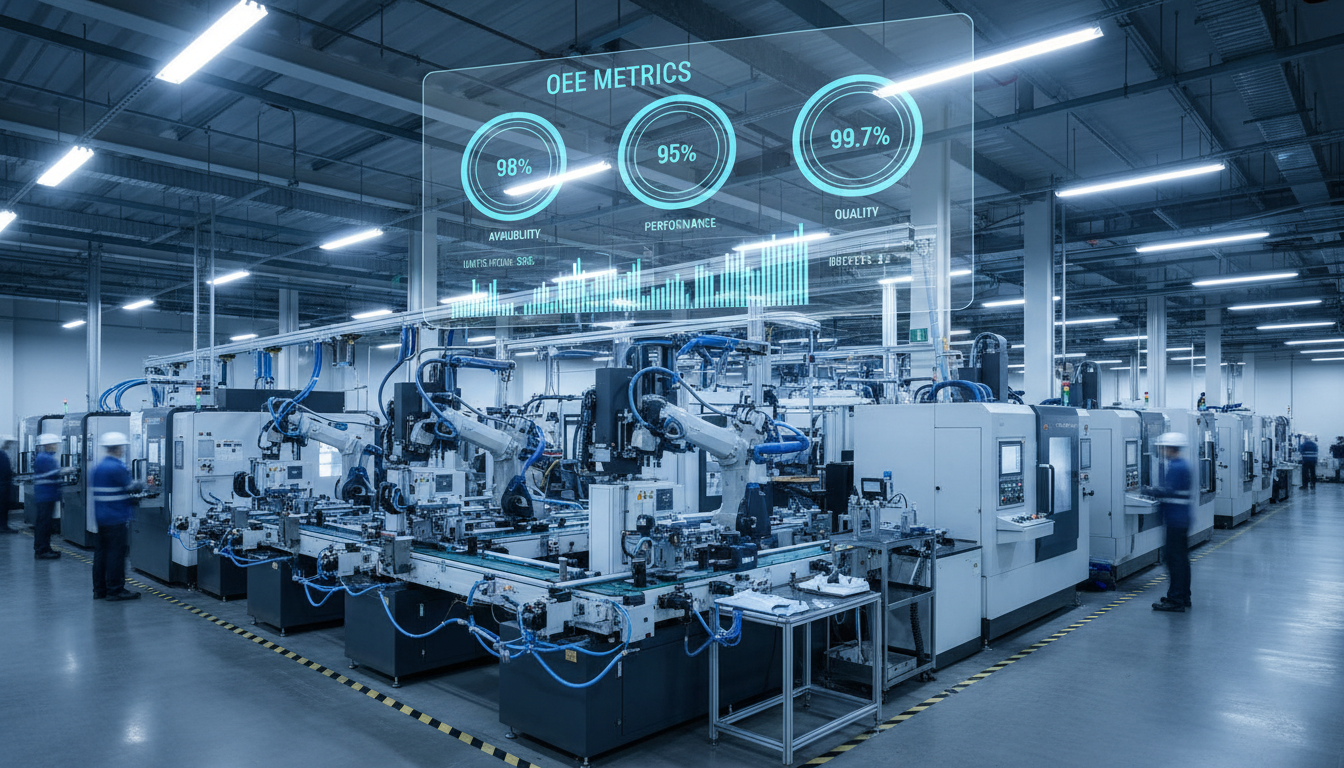
OEE measures manufacturing productivity across three components:
- Availability – Is the machine running when it should?
- Performance – Is it running at optimal speed?
- Quality – Are we producing good parts without defects?
The formula:
OEE = Availability × Performance × Quality
An OEE score above 85% is considered world-class, but many factories operate below 60% due to hidden inefficiencies.
Common Reasons for Low OEE
Before improving OEE, it’s important to understand typical issues:
- Unplanned machine downtime
- Micro-stoppages that go unreported
- Manual production tracking
- Inaccurate shift-level reporting
- Delayed root-cause analysis
- Lack of real-time visibility
Without connected systems, these inefficiencies remain invisible.
How Industrial IoT Improves OEE
Industrial IoT enables real-time production monitoring directly from machines and PLCs.
Here’s how it makes a difference:
1. Real-Time Downtime Detection
IoT-connected systems automatically detect:
- Machine start/stop times
- Downtime events
- Idle durations
- Micro-stoppages
Instead of relying on manual logs, you get accurate machine-level data instantly.
2. Automated Performance Tracking
By connecting sensors and controllers, you can measure:
- Actual cycle time
- Production counts
- Speed losses
- Target vs actual output
This eliminates guesswork in performance evaluation.
3. Quality Monitoring Integration
IoT systems can integrate:
- Rejection data
- Quality inspection inputs
- Defect tracking metrics
You gain clear visibility into quality-related production losses.
4. Live OEE Dashboards
Modern Industrial IoT platforms provide:
- Shift-wise OEE
- Line-wise OEE
- Plant-level dashboards
- Historical performance trends
Management and shop-floor teams view the same real-time data.
5. Root-Cause Analysis & Continuous Improvement
With centralized production data:
- Identify recurring downtime causes
- Compare performance across shifts
- Benchmark lines and plants
- Track improvement initiatives
OEE moves from a reporting metric to a decision-making tool.
Benefits of IoT-Based OEE Monitoring
Manufacturers implementing Industrial IoT-based monitoring often achieve:
- 5–20% improvement in OEE within months
- Reduced unplanned downtime
- Faster decision-making
- Better shift accountability
- Improved cross-plant visibility
Cloud vs On-Premise Deployment for OEE
Modern systems allow:
- Cloud-based deployment for centralized visibility
- On-premise deployment for regulated industries
- Hybrid edge-cloud architecture for critical operations
Choosing the right architecture depends on IT and operational requirements.
Getting Started with OEE Optimization
To begin improving OEE using Industrial IoT:
- Identify critical production lines
- Connect machines via gateways or PLC integration
- Define downtime categories
- Deploy real-time dashboards
- Train teams to act on data
Start small. Scale across plants.
Conclusion
Improving OEE is not about collecting more reports — it’s about enabling real-time operational intelligence.
Industrial IoT transforms OEE from a monthly calculation into a live performance indicator that drives continuous improvement.
Manufacturers who adopt connected production monitoring gain a significant competitive advantage in efficiency, cost control, and operational excellence.